How to Write a Design Brief When You’re Not a Designer
By Rigoris Digital
The short answer
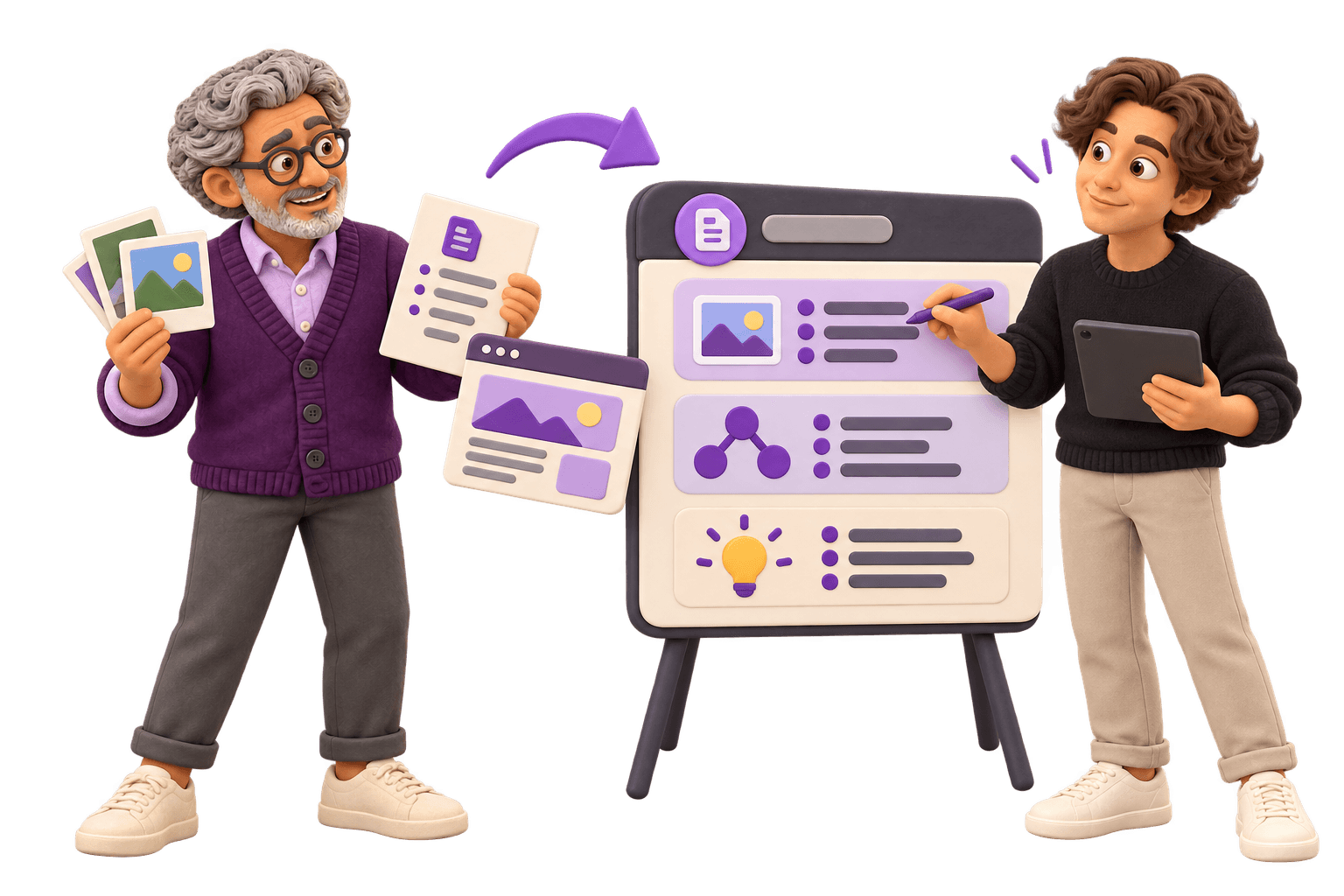
You don’t need a polished design brief before your first design meeting. Bring raw material instead: who your customer is and what they’re trying to do, what success would look like, what must not change, three things you admire and two you dislike with reasons, and your real constraints. The designer should turn that into the brief.
TLDR
- You don’t need a polished design brief before the first conversation. Writing the brief is part of the designer’s job.
- Your job is raw material: who it’s for, what should change, what must not change, things you admire and dislike, and your real constraints.
- “Clean and modern” isn’t wrong, it’s unfinished. Finish it with an example and a because.
- The reasons you dislike something are often more useful than the reasons you like something else.
- A brand conversation and a product UX conversation need different material. One is about how you’re seen. The other is about how a task gets done.
- After the meeting, the designer should send the brief back to you in their own words, for you to correct.
The blank document problem
A designer asked you to send a brief before the first call, and you’ve opened a blank document three times. You don’t have brand guidelines. You aren’t sure whether you need UX, UI or both. The only words you’ve got are “clean and modern,” and you suspect everyone says that.
So you search for how to write a design brief and find templates asking for your unique selling proposition, target personas, success metrics, deliverables and a competitive analysis. That isn’t the input to a first conversation. It’s roughly what the first few weeks of design work should produce, and the templates want it from you before you’ve hired anyone.
Here’s the short version. Bring raw material, not a finished document. The designer’s job is to ask the questions and structure the answers. Yours is to know your business, which you already do.
How to write a design brief: let the designer write it
This isn’t a shortcut. It’s how good design work is supposed to start. The Nielsen Norman Group’s guide to stakeholder interviews describes the designer interviewing the client, not the other way round, to gather the history, the known constraints, what’s already been tried and a shared definition of success. You answer. They organize.
The UK’s Design Council builds the same idea into the Double Diamond, its model of the design process. The first stage “helps people understand, rather than simply assume, what the problem is.” A designer who treats your brief as the final word has skipped that stage.
That’s also why a polished brief can backfire. “Blue, minimal, like Apple” reads as organized, but it hands the designer a conclusion before anyone has checked the problem. Six honest notes about your customers give them more to work with than a page of confident answers to the wrong questions.
Six things to bring to the first conversation
None of these needs design vocabulary. Plain sentences are better. Notes on your phone are fine.
1. Who it’s for, and the moment they meet you
Skip the demographics. Describe a real customer at the moment they meet your brand or use your product. A homeowner whose furnace quit at nine at night, comparing three companies on a phone. An office manager who reorders the same supplies every Monday and resents every extra click. What do they need to believe, or get done, in that moment? Who else are they looking at?
2. What would be different if this worked
Say it the way you’d say it to your business partner. “Commercial customers call us, not just homeowners.” “People stop phoning to ask where their order is.” “We look like a firm that could handle a hospital contract.” Those beat any adjective, because a designer can design toward them and you can both check them later.
3. What must not change
First-time clients forget this one, and it matters most for an established business. Maybe it’s the red your trucks have been painted for decades, the name customers search for, the phone number on every fridge magnet, or the screen your staff finally learned.
That recognition took years to build. Marketing scientists at the Ehrenberg-Bass Institute describe logos, colours and slogans as assets a brand builds over time, and warn that a dramatic change “can write off this long-term investment in an instant.” Tell the designer what customers already recognize before they start, not after the first round of concepts. If you’re starting from nothing, say that too. It’s useful information.
4. Three things you admire, two you can’t stand, and why
Screenshot three brands, sites or apps you like. They don’t have to be in your industry. A hotel’s booking page can say more about what you want than your best competitor’s site. Under each one, write a sentence about why. “I can see the price before I call.” “It feels like the owner answers the phone.” That sentence is the design vocabulary you think you don’t have.
Then add two you dislike, with reasons. Dislikes are often more useful than likes, because they mark the edges. “Too corporate” and “looks like a template” tell a designer where not to go, which can save a whole round of concepts.
5. What you have now
Bring everything that carries your name today: the logo file, the website, a photo of the van, a quote you sent last month, your social profiles. For a product, bring screenshots, the spreadsheet people use instead, the paper form and the email chain that shows where things fall apart. If you mocked something up in an AI tool last weekend, bring that too, with a note on what you like about it. Treat it as a sketch for the conversation, not a design to be polished.
6. Your real constraints
Only the real ones. A trade show date, a lease ending, a launch your investors already know about. Who has to approve the work, including the business partner who isn’t coming to the meeting. Where it has to work, from a van door to an app icon to an invoice printed in black and white.
And the budget range you’re working within, even a rough one. It changes what a designer should propose: how many directions to explore, how much research to do, how many surfaces to design. Saying it early keeps the proposal honest.
Turn “clean and modern” into something a designer can use
You don’t need new words. You need to finish the ones you have. Every adjective in a first design conversation is shorthand for something specific, and the designer can’t guess which. Add an example and a because:
- “Clean” might mean “I can find the phone number in two seconds.”
- “Modern” might mean “doesn’t look like our current site, which hasn’t changed in ten years.”
- “Premium” might mean “a hospital facilities manager would trust us with a contract.”
- “Friendly” might mean “feels like talking to the owner, not a call centre.”
- “Simple” might mean “my staff can do it without calling me.”
None of those is a design instruction. They’re statements about your customers and your business. Turning them into type, colour and layout is the designer’s work. Giving them something real to aim at is yours.
A brand conversation and a product conversation need different things
The six items apply to both, but the emphasis shifts. A brand identity conversation is about how you’re seen, by whom, next to whom. A product UX conversation is about how a task gets done, by whom, and where it goes wrong. Bring the material for the conversation you’re actually having.
| For the first meeting | Brand identity | Product UX |
|---|---|---|
| What the designer needs to learn | What customers should believe about you, and what they believe now | How a real task gets done today, step by step, and where it breaks |
| The most useful thing to bring | Photos of everything that carries your name, side by side | A recent real example of the task, with the forms, messages and spreadsheets involved |
| References that help | Brands from any industry, chosen for how they make you feel | Products that handle a similar task well, chosen for what they let you do |
| What must not change | The colours, name, marks and phrases customers recognize | The steps, terms and screens people already rely on |
| Leave at home | A logo you’ve already decided on | Screen layouts you’ve already decided on |
Plenty of businesses need both. Say so at the start. The order matters, and a designer should be able to tell you which one they’d do first and why.
What should happen after the meeting
A good first conversation ends with the designer writing the brief, not you. Within a few days you should get it back in their words: the problem, who it’s for, what must not change, what they took from your references and what they’ll show you next. Your job is to correct it. If it reads like they understood the business, you’ve found the right person. If it reads like a template with your name in it, you’ve learned that too.
Watch for two warning signs. A designer who answers every question with “what do you prefer?” is handing the structuring back to you. A designer who asks almost nothing and sends logos the following week skipped the part where they find out what the problem is.
That’s how we’d want any first design conversation to go, ours included: we ask, you talk, and the brief comes back from us for you to mark up. Guidance is the part of the work you’re paying for. Here’s how one client, Elliott Carney Killan, Owner, First Refrigeration Engineering Ltd., described working with us:
They gave us excellent guidance on how to effectively enhance our small business’s identity. We were able to maximize website design and performance for a flawless user experiences thanks to their proactive advice and clear communication
The identity and website themselves are on the First Refrigeration project page.
Before the call, write three lines
Open a note on your phone and write three lines: who it’s for, what should be different if this works, and what must not change. Then screenshot three things you admire and two you don’t, and write one sentence under each about why.
That’s enough to start. If a designer can’t turn it into a brief, more homework from you won’t fix it. When you’re ready to see how brand and product design fit together once the brief exists, our branding and UX design page walks through it.
Common questions
No. Brand guidelines are usually something a designer produces, not something you bring. Bring what exists instead: your current logo files, any colours or fonts you already use, and photos of the places your name appears. If guidelines exist from an earlier project, bring them along with what you think they got wrong.
Expect questions about your customers, why the project is happening now, what success would look like, what you’ve tried before, what must stay the same, who approves the work, and your timing and budget. A good designer also asks why you like the references you bring. If they mostly ask about colours and fonts, they’ve skipped ahead.
A brand designer shapes how your business is recognized and perceived: the logo, typography, colour and the rules for using them. A UX designer shapes how people get a task done in a website or app: the steps, the information and what happens when something goes wrong. Some projects need one, and many need both.
Yes, even as a rough range. Budget changes what a designer should propose, such as how many directions they explore, how much research they do and how many surfaces they design for. Without it you’ll get a proposal shaped around a guess, and comparing proposals from different designers gets harder.
More Posts
AI Agent or Custom Software? Ask What It’s Standing In For
AI agent or custom software? Before you pay for either, check whether the agent would be covering for missing data, unwritten rules or no owner.
Next postDoes Your Accounting Firm Need a Website or a Workflow Fix?
Work out whether your accounting firm's constraint is enquiries, client hand-offs or delivery before spending on a website or software project.