Web app development · B2B SaaS
Web app development for B2B SaaS companies
Your customers live in your web app for hours at a time, so every change to it carries risk, and the parts that annoy them daily rarely reach the roadmap. We build and extend B2B SaaS web apps with the expensive decisions made first: roles, integrations and the tools your own team runs on.
Sound familiar?
Where B2B SaaS web app projects usually start
Most of this work starts inside a product that's already live, with customers depending on it and a roadmap that won't wait.
Permissions were added one request at a time
Roles grew as customers asked for them. Now your largest account wants a custom role and single sign-on, and every new screen has to work around how access was bolted on.
Screens built for the demo, not the data
Tables that looked fine with forty rows struggle with forty thousand. Filters reset on refresh, and your heaviest users have quietly started exporting to spreadsheets.
Your own team runs the business by hand
Support, operations and finance rebuild answers in spreadsheets because the admin tool was never designed, and anything they can't see gets escalated to engineering.
Your engineers are booked through next quarter
A large customer is waiting on a release that isn't on anyone's plan, and you can't hire fast enough to build it without pulling your team off the roadmap.
What we build
Web apps we build for B2B SaaS companies
Most projects combine several of these, scoped to the release you need next rather than to everything the product might one day become.
Customer-facing web apps
The product your customers work in all day: queues of records, comparisons, reports and the settings behind them, built for a keyboard and a wide screen.
Roles, permissions and single sign-on
An access model decided before the interface: workspaces, account owners, custom roles where customers need them, and single sign-on for the accounts that ask.
Data-dense screens
Tables with filters that persist, saved views, bulk actions, side-by-side panes and exports people can use, tested against your largest account's real row counts.
Internal admin dashboards
The tool support, operations and finance run the business from, with the same permission model as the product and an audit trail on every action taken on customer data.
Integrations
Connections to CRMs, billing providers and your customers' own systems, built to tell someone when they fail and to replay what didn't land without creating duplicates.
Features inside your existing product
A defined part of the product built inside your codebase, through your review process and your pipeline, while your team keeps its own roadmap moving.
How it works
How a B2B SaaS web app build runs
The order is the point. Permissions, data volumes and integrations get settled before anyone designs a screen, because those are the parts a live product can't change cheaply.
Discovery from your own data
We work from your database, your support team and your integration documentation: the record everything hangs off, the real shape of your largest account, row counts and every system the app talks to. You get a written scope stating what's included and what isn't.
Design for real volumes
User flows and screens for your customers and for your own team, reviewed with you before development starts. The busiest screens get designed against your heaviest account, not a demo with forty rows.
Build through your pipeline
We build in stages you can try, with the permission model and data structure in place before the screens that depend on them. In your codebase, our work goes through your review process and your pipeline.
Release to one account first
The first release goes to one real account you can phone before it goes to everyone. A reaction you can hear tells you more than a beta programme will.
After launch
We stay on to fix, adjust and keep building as your roadmap moves. Many of our engagements run as ongoing partnerships for a year or more.
What you get
What you have at the end of a build
Everything your team needs to run the release, extend it, and answer a customer's security review about it.
- A fixed cost, agreed against a written scope before the build starts
- Acceptance criteria for every deliverable, so done means the same thing to both of us
- A documented roles and permissions model your engineers can extend
- A working release, with the admin tooling your team needs designed as part of it
- Integrations that alert someone when they fail and can replay safely
- Code in your repository, with documentation your engineers can work from
Your product, your team
Working inside a live product and alongside your engineers
A SaaS product never stops shipping, and your customers use it while we work. So we scope a defined release rather than the whole product, and we extend what you have unless there's evidence a rewrite is worth the months where nothing visible improves.
Two arrangements work with an in-house team. We design and specify while your engineers build, or we take a defined part of the product and ship it ourselves while your team keeps its roadmap moving. Either way, the code lands in your repository under your conventions, and who looks after it once it's live is agreed before the first pull request.
What we don't do is supply developers to work through your tickets. If what you need is extra capacity managed by your own lead, a staff augmentation firm is the better fit. We take on a defined piece of work and stay accountable for the result.
Why Rigoris
Why work with us on a B2B SaaS web app
An outside team building part of your product should take work off your engineers' plates, not add a project for them to manage.
A fixed cost for a defined release
We scope the release with you and quote a fixed cost, so a roadmap change moves a boundary everyone can see instead of running up an open meter.
Strategy, design and development in one team
The people who scope the permission model are the people who build it, so the reasons behind a decision don't get lost in a hand-off between firms.
Honest about the size of the release
If the first release should be smaller than the one you arrived with, we'll say so during scoping rather than three months into the build.
Related work
See the work in context.
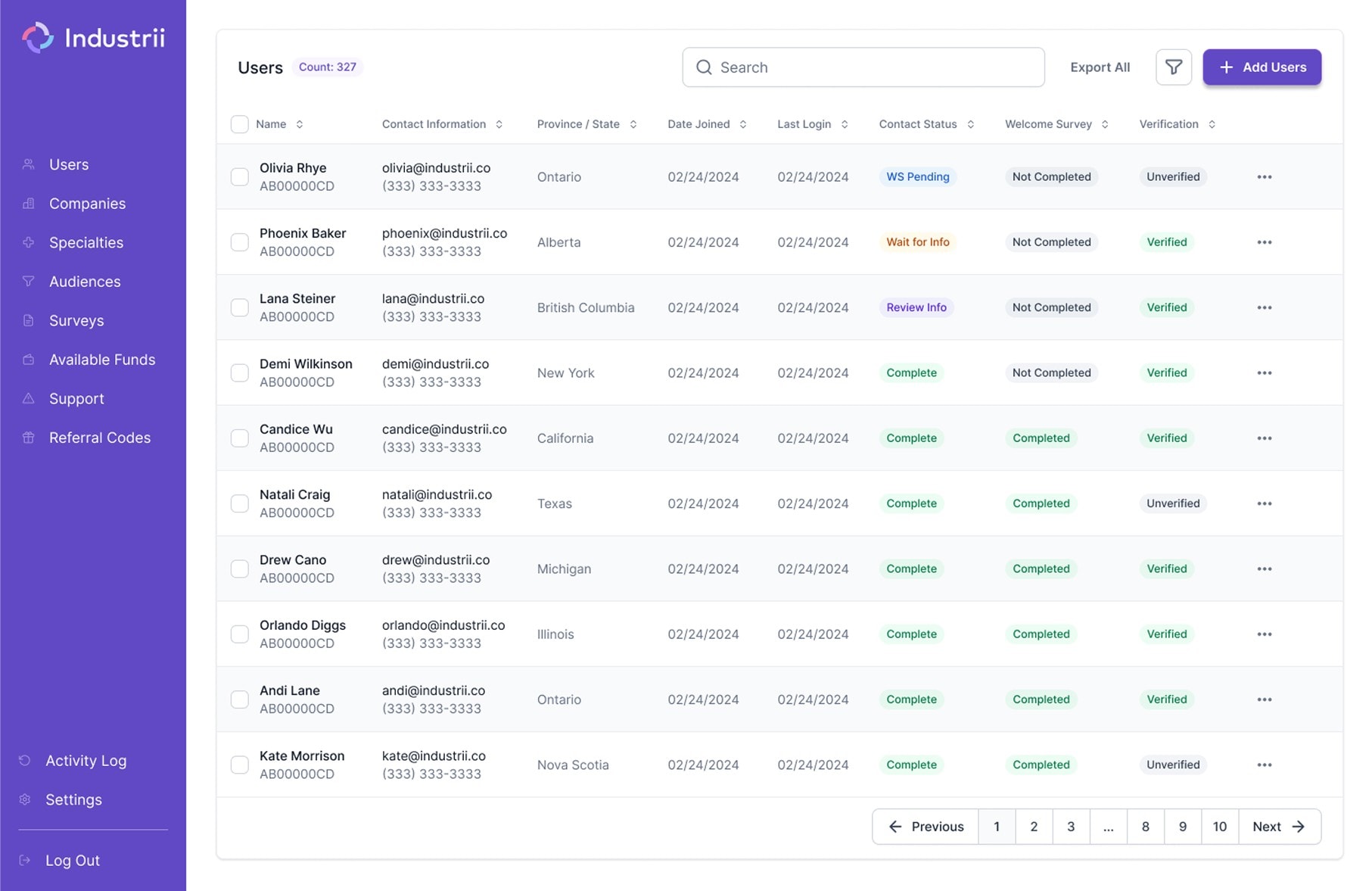
CTC Communications Corporation
Industrii
Surveys for Healthcare Professionals
UX/UI Design · Mobile App Development · Web App Development
Explore the case studyBefore we talk
Common questions
Either, and what decides it is where your team's attention is worth more this quarter rather than what either side is capable of. If your engineers are the only people who understand the part being changed, we design and specify and stay available while they build it. If they're mid-way through something they shouldn't be pulled off, we take a defined part of the product and ship it ourselves.
By scoping a defined first release rather than the whole product. A release you can describe precisely is one a changing roadmap can move around, because everyone can see what moving it costs. A release described as a theme is one where every quarter's change lands as an argument about what was meant.
It depends on the scope, so we quote a fixed cost once discovery has defined it. The things that move the number most are how many roles need different views of the same records, how many systems the app connects to and how well documented they are, whether the internal admin tooling is in scope, and whether existing data has to move across from the current product.
Both, with one team. If you already have designs or a design system, we build from them. If not, user flows and screens get designed and reviewed with you before development starts, including the admin screens your own team will use.
If you want us to, we stay on as an ongoing partnership on a fixed monthly fee rather than hours. The team that built a feature is then the team that extends it, fixes it and adjusts it as your roadmap moves.
Worth reading first
More for B2B SaaS
Web app development for other industries
Your next step
Bring the part you're unsure about.
A short call is usually enough to tell whether this is the right work for you. You'll leave it knowing what the first piece of work would be, and if we're not the right fit, we'll say so.