Website design & development · Accounting firms
Website design for accounting firms
You've priced the template products built for accounting firms, and on paper they're hard to argue with. For a firm that mainly needs a credible presence, that's often the right call. We build for firms whose site has to do something a layout can't, like explain a specialism or help a client see they're a fit before the first call.
Sound familiar?
Where website design for accounting firms usually starts
Most firms arrive with a site that technically works and quietly doesn't do the job they need from it.
Your site says what every firm says
Tax services for small business, bookkeeping, advisory. A visitor can't tell in two seconds whether you handle their situation, so they keep looking.
Your specialism gets one paragraph
The work you're best known for sits on a page the same shape as every other, with a stock photo and a list of services.
The first call is spent finding out it's not a fit
The contact form drops into a shared inbox, and nobody can tell from it whether the person writing is someone you'd take on.
You're nervous about a rebuild
Some of your current pages earn traffic, and you've heard rebuilds lose rankings. Nobody has said what happens to the old addresses.
What we build
What website design for accounting firms includes
The visual design matters, but most of the value is decided before it: what the site is built around, and what it's allowed to claim.
A structure built around client situations
Service lines regrouped into the situations that produce your best clients, named the way those clients describe their own problem.
Situation and specialism pages
Short pages that say who it's for, what usually prompts the call and what the first month looks like. A specialism gets the depth its argument needs.
Copy you can substantiate
Every claim traced back to something the firm can back, so whoever signs off on marketing approves the page instead of defending it.
Designed page types and rules
The page types designed against the structure, with the type, colour and spacing rules that keep every later page consistent.
Booking and intake wired in
The first step connected to the intake, scheduling or client portal you already run, rather than a generic form landing in a shared inbox.
Redirects and enquiry tracking
Old addresses mapped to the new structure before launch, and enquiry tracking in place so there's a baseline to compare against.
How it works
How an accounting firm website project runs
Structure first, then copy, then design, then build. Approving a design before anyone has decided what the pages have to say is the most common way this goes wrong.
Discovery interviews
We talk to the partners and whoever fields the first call about which clients matter commercially and how they describe their problem. A few hours across two or three people, outside a filing week.
The situation map
Your services get regrouped into situations, and anything that doesn't earn its own page is named as such. One partner settles what the firm is and isn't for.
Copy and the substantiation pass
We draft the pages with you, then trace every claim to something the firm can back with whoever signs off on marketing, before any of it reaches design.
Design and build
The page types are designed against the structure and built with the first step connected to your intake or scheduling. You get a list of what your team can change without calling anyone.
Launch and the first-quarter review
Redirects and indexing get checked on launch day. Then we go through a full quarter of enquiries with you, looking at fit as well as volume.
What you get
What you have at launch
A site your partners can defend line by line, and that your own team can keep current.
- A page-by-page structure built around your clients' situations
- A copy deck your reviewer can approve, with every claim traced to something you can back
- Designed page types and the rules that keep new pages consistent
- A working site connected to the intake or scheduling you already run
- A redirect map from every old address to its new home
- Enquiry tracking, and a written list of what your team can change themselves
Professional conduct
Written to clear your own conduct rules
An accounting firm's marketing sits inside its professional conduct code, and the code names websites. In Ontario, CPA Ontario's Rule 217.1 says a firm mustn't advertise in a way that's false or misleading, or make a claim it can't substantiate. Calling the firm a specialist carries its own test. Other provinces and states publish their own versions, and your governing body's current text is the authority, not us.
So we treat claims as part of the content work rather than something to cut at partner review. Stock wording in a template, like "our team of specialists" or a services list inherited from the demo, is somebody else's to write and yours to sign. A page built from what you can back gets approved.
The honest limit is that the substance has to come from your team. We handle the structure and we'll draft, but how your firm works, which clients you're best for and what you'd turn away can't be written from outside. If nobody in the firm can give a few hours to interviews, a template will serve you better than a custom build.
Why Rigoris
Why work with us on your firm's website
You shouldn't have to judge a layout to judge whether the site will work. Ask who decides the structure and who writes the words.
We'll tell you when a template will do
If your site's job is to confirm that a firm someone was referred to is real and reachable, a vertical template does it faster. We'd rather say so on a first call.
The words are part of the quote
We structure and draft the copy rather than leaving it for you to supply later, because that half of the project decides whether the site works.
One team, one fixed cost
The same team runs the interviews, the design and the build at a fixed cost agreed before work starts, and hands over a site your own people can edit.
Related work
See the work in context.
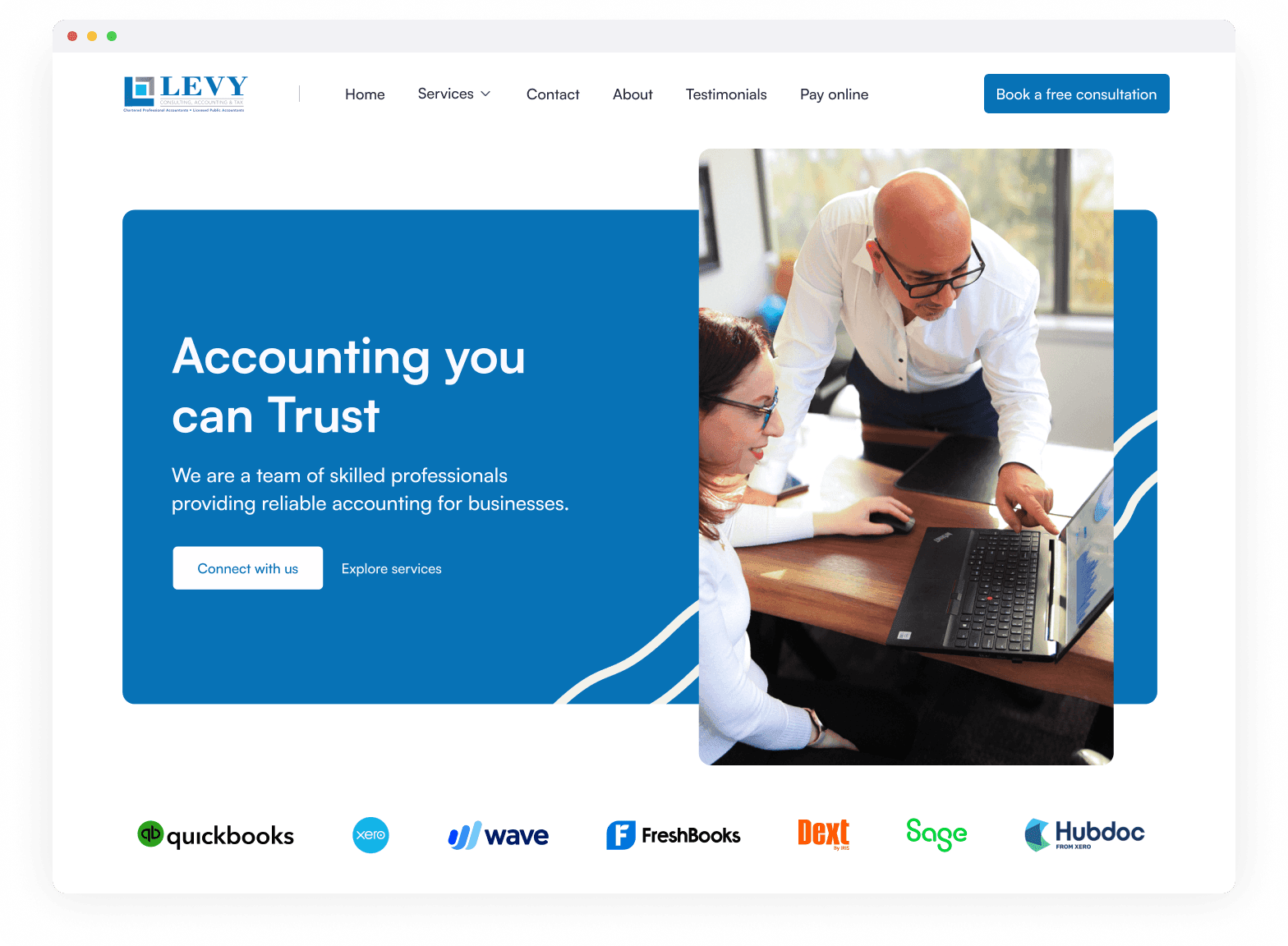
LCAT Accounting
LCAT
Accounting Services Website Redesign
Product Strategy · UX/UI Design · Website Development
Explore the case studyBefore we talk
Common questions
Often, yes. If the site's job is to confirm a firm someone was already referred to, a vertical template does that faster than we can. It stops being the right call on two decisions: what the structure gets built around, and what the first step connects to. If either answer is specific to your firm, a layout has already made it for you.
Six to ten weeks from kickoff to launch is typical, depending on how much content already exists and how many people inside the firm review it. Discovery and content structuring usually take longer than the build. The real risk to that timeline is partner review, not development, which is why we schedule this work away from filing deadlines.
Usually, yes, and we'll check whether that's the better call before recommending a move. Staying put makes sense when the platform is sound and the problem is structure. Moving makes sense when the current setup blocks something you need, or when nobody on your team can edit it without help. We'd rather not migrate you for the sake of it.
We handle structure and we'll draft, but the substance has to come from your team. How your firm works, which clients you're best for, and what you'd turn away are what make a page credible, and we can't write those from outside. Expect to give us a few hours of interview time.
It depends on the scope, so we quote a fixed cost once it's defined. What moves the number most is how many situations and specialisms earn their own page, how much usable content already exists, whether the first step connects to intake or scheduling you already run, and how many existing pages need migrating and redirecting.
Worth reading first
More for accounting firms
Website design & development for other industries
Your next step
Bring the part you're unsure about.
A short call is usually enough to tell whether this is the right work for you. You'll leave it knowing what the first piece of work would be, and if we're not the right fit, we'll say so.