
Product strategy and discovery
The most expensive feature is the one nobody needed.
We do the research, scoping and sequencing that decides what gets built, so the budget goes into the version that proves the idea rather than the version that has everything on it.
Flows and wireframes
For anything user-facing
A written scope
In, out, and explicitly out
Acceptance criteria
Attached to each deliverable
A change process
Agreed before it's needed
What we build
The work that decides what the build is.
Discovery
Flows, wireframes, a written scope saying what's included and what is explicitly excluded, and acceptance criteria attached to each deliverable. Artifacts, not vibes.
User and market research
We talk to the people who'd actually use it and look hard at what already exists. Then we tell you what we found, including the parts you were hoping we wouldn't.
Roadmaps
A sequence with a reason for the order and a measure attached to each release, so the question of whether you're ahead or behind has an answer rather than an opinion.
A second opinion
A read of the plan, the scope and the code you already have, and a straight answer on whether to continue, change course or stop.
How it works
Learn the business, then cut the list.
Learn the business
What makes the money, what breaks, what's been tried and quietly abandoned. Product opinions come after that, and they're worth less before it.
Go and look
Users, competitors and the constraints nobody wrote down. You get findings you can read and argue with, not a deck of adjectives.
Cut
We propose the smallest version that proves the thing. This is usually the part where we tell you to build less than you planned, and it's the part that pays for the phase.
Write it down
Flows, wireframes, scope, acceptance criteria and a change process, detailed enough that a different team could build from them without calling us.
The sequence, argued about before anyone builds to it.
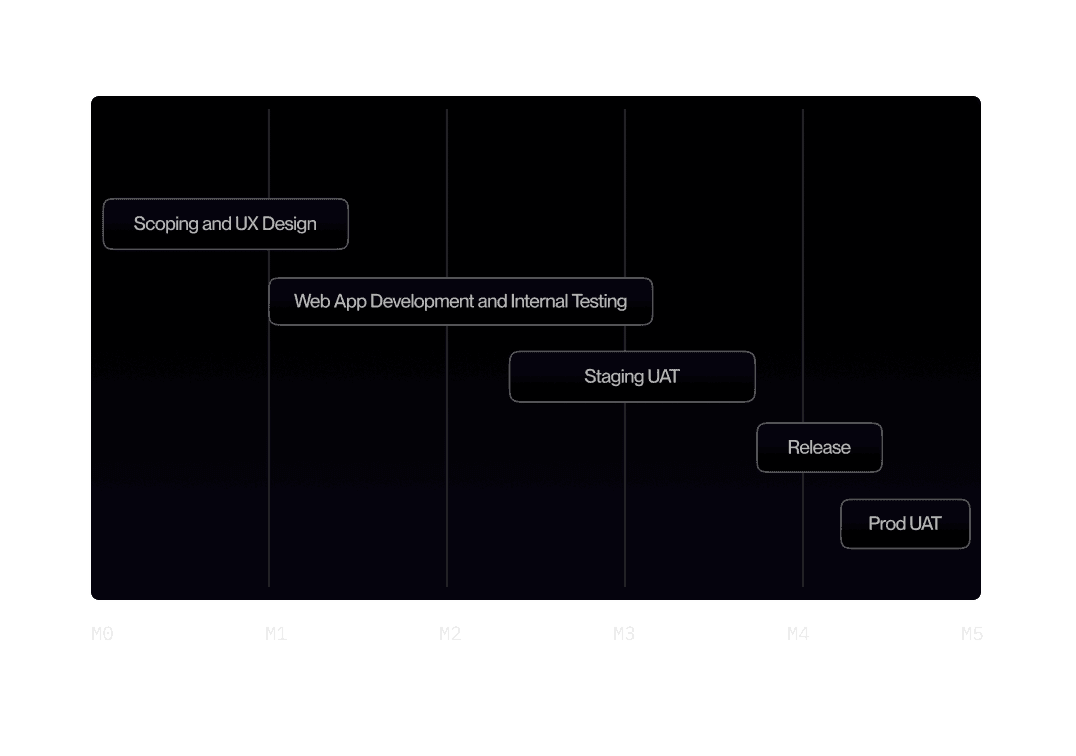
Scoping and design first, then the build, then testing on staging with your own people in it, then release. Every bar sits where it sits for a reason, and each one has something that has to be true before the next can start. This is the picture worth arguing over. Arguing about a feature halfway through construction costs a great deal more.
Being straight with you
When this isn't what you need.
The scope is written and you trust it
If someone competent has already done this work and you believe the document, don't pay for it twice. Go and build.
Custom developmentIt's five pages of marketing site
A brochure site doesn't need a discovery phase. It needs someone to decide what the pages say and write them properly.
Website design and developmentYou need to know if the build is salvageable
That's a narrower question than strategy, and it has its own review with a shorter answer at the end of it.
Product readiness reviewQuestions we get before the first call
The ones people ask once they trust you enough to ask them
You can. The cost shows up later as an integration nobody scoped and a permissions model nobody discussed. Discovery is the cheapest place to find those, because changing a wireframe costs an afternoon and changing a shipped feature costs a sprint.
User flows and wireframes for anything user-facing, a technical scope stating what's included and what is explicitly excluded, acceptance criteria per deliverable, and a defined change-request process.
No. The output is written so another team could work from it. We'd rather you had a scope you can take to three firms than a document only we can read.
Then we tell you, and you found out for a fraction of what a build costs. That's the outcome this phase exists for, even though it's the one nobody wants when they commission it.
The people who'd be accountable for delivering it. You're not handed to a different team the moment the strategy is signed off.
Bring the idea. We'll tell you what's worth building first.
A short call about the business, not the feature list. You'll leave with a sharper version of the thing you came in with.