Product strategy · Accounting firms
Product strategy for accounting firms, before the build
The short answer
Product strategy for an accounting firm is the work of deciding whether to build at all. It covers which manual process is genuinely costing you, whether software or a process change fixes it, what the smallest first release has to prove, and what you'd buy off the shelf instead. You end with a scoped plan, not a build commitment.
Someone in the firm has an idea for a portal, and nobody can say what it's worth. Or a manual process has quietly become the thing stopping you from taking more clients. Both of those are product decisions before they're build decisions, and getting that order wrong costs considerably more than getting the build wrong.
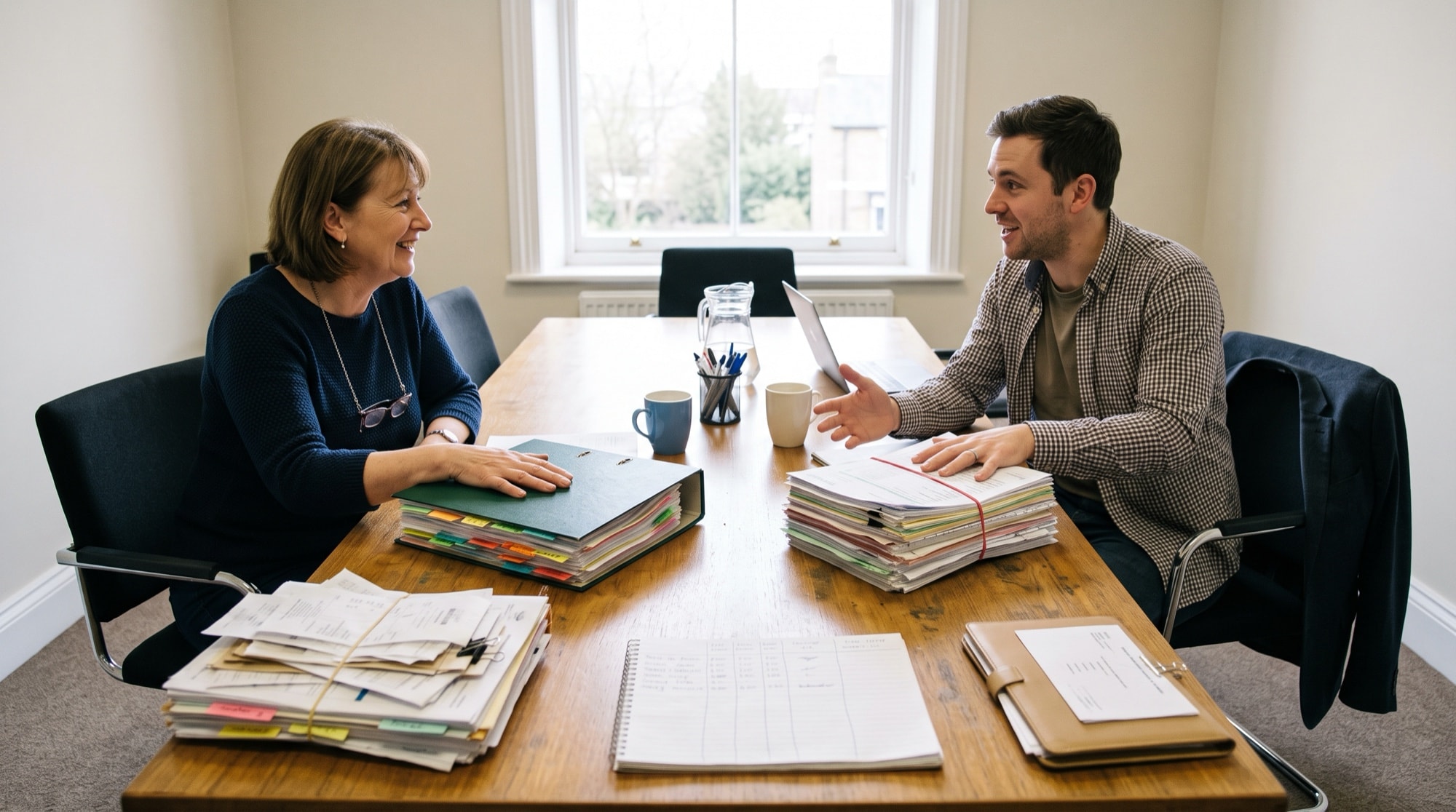
Start with the process, not the product
The idea almost never arrives as a problem. It arrives as a solution. Somebody says the firm needs a client portal, and the portal is the shape of the conversation before anyone has said which task it removes, from whom, and what that task currently costs.
Translating it back is where most of the scope disappears. A partner meeting will produce four candidate processes and a shared sense that all of them hurt. One is usually worth building against, and it's rarely the one with the loudest advocate. It's the one that costs the most and can't be fixed by deciding something.
The order matters more than the analysis. Process first, then what it costs, then whether anything you already own closes the gap, and a build only if it survives all three. Run it the other way round and you'll spend the discovery budget specifying a portal rather than finding out whether the firm needs one.
Buy, configure, or build
This is a three-way decision and it almost never gets held open as one. By the time somebody is asking what a build would cost, the firm has usually ruled out configuring what it already owns without checking, and skipped past buying because a demo went badly two years ago.
Practice management and client portal software is a mature category, and that cuts both ways. It means something close to what you want probably exists. It also means the only thing worth measuring is the gap between your process and the one the category assumes, because that gap is what you'd be paying to build.
This question is also a fast way to judge anyone you might hire. Ask what they'd tell you not to build, and listen for whether the answer is ready or improvised. A firm that has never talked a client out of anything has never had the conversation.

| Option | When it's genuinely right | The sign you've chosen wrong |
|---|---|---|
| Configure what you already own | The capability exists in your practice system or portal, and nobody switched it on or trained anyone on it | You're commissioning something that appears in your current vendor's release notes from two years ago |
| Buy something else in the category | Your process is close enough to what the category assumes that the gaps are annoyances rather than blockers | Six months in, half the firm still runs the old spreadsheet alongside it, because the tool can't hold an exception you hit weekly |
| Build it | The workflow is what you sell, or the category doesn't run your process, or per-seat licensing has become the limit on adding clients | Your requirements could be met by three products you can name, and the reason you're not using them is preference rather than fit |
What discovery actually runs through, in order
Discovery gets sold as a vague thinking phase, which is why firms resent paying for it separately. Run properly it's a sequence with an output at every stage, and you can check it as it goes rather than waiting for a document at the end.
The order carries most of the value. Each stage exists to kill a version of the idea cheaply, and the stages that get skipped for time are reliably the ones that would have killed it.
1. Sit with the person who runs the process
Not the partner who owns it, the person who performs it. Walk one real client through the whole thing in the actual system, and write down every exception mentioned in passing. Those exceptions are what no process diagram has ever contained and what breaks a build in month four. An afternoon here changes more scopes than a week of workshops does.
2. Put a number on what it costs
Hours per client per cycle, multiplied by your client count, then checked against the season rather than an average month. Do the same for the client's side of it if they're involved. Most firms find one step dominates and two they were worried about barely register. Every decision after this gets weighed against that number, so get it honestly.
3. Rule out the cheap fixes
Two of them, in this order. A process change, where a step survives only because nobody has revisited a decision. Then configuration, where the thing you want already exists in software you're paying for. Both resolve in weeks rather than quarters. If either closes most of the gap, discovery has paid for itself and the build stops right here.
4. Name the assumption the whole idea rests on
In a firm the assumption is nearly always about behaviour rather than technology. Will clients use this instead of emailing you, and will your own staff use it instead of working around it. Write it as a sentence someone could later be proved wrong about. If the first release doesn't test that sentence, the release is aimed at the wrong thing.
5. Draw the first release and its edges
Draw the paths first, then write the edges. The drawing is the easy half. The list of what this release deliberately leaves out, and why each thing is out, is the half that gets skipped and the half that matters. Every exclusion is a small argument with somebody, which is why it's harder. It's also what stops a first version from quietly becoming the whole system.
6. Define done, and define change
Both get written before any work starts, which is the only time either one is genuinely negotiable. Acceptance criteria settle what done means while nobody yet has an interest in the answer. A change process settles the route for a request nobody has made yet. Every firm asks for changes. The ones that go badly are the ones where the route got invented under pressure.
7. Make the decision explicitly
Discovery ends with a recommendation, and it has to be said out loud. Build this, build a smaller version of it, or don't build. A plan that arrives without a recommendation hands the judgment back to the people who went looking for a partner precisely because they didn't have it. Ours names which of the three, and why.
Productising a service is a delivery change first
Turning an advisory service into a product means fixing its scope, its inputs, its outputs, and what's explicitly excluded. That's a delivery decision and it's the hard part. Software makes a standardised process faster. It cannot standardise one for you, and trying to make it do so is how firms end up with a tool nobody uses.
Fixing the scope means four specific things: naming the inputs you require before you'll start, naming the outputs a client gets and the form they arrive in, setting how many rounds of back and forth are included, and writing down what pushes a client out of the standard version into a custom one. Most firms hold all four opinions already. They're just held in different partners' heads and have never been reconciled.
A useful test: could you run the productised version manually, for three clients, next month, with a spreadsheet and a checklist? If not, you don't have a product yet, you have an intention. Run it by hand for one cycle first. Everything that breaks becomes the specification, and it's a much cheaper place to find out.
What the first release has to prove
A first release is an argument, not a version. It should be small enough to ship inside one quiet quarter and pointed squarely at the assumption that would sink the whole idea if it turned out to be wrong. Everything that isn't testing that assumption is a candidate for the second release instead.
Whatever it's pointed at, the result has to be something you'd notice without commissioning a study. A number of clients using it without being chased. A step that stopped producing internal email. A partner who no longer reviews something by hand. Conditions like better efficiency are unfalsifiable, which is comfortable at the time and useless a year later when nobody can say whether it worked.
It runs alongside, not instead
The version of this that fails is the switch-over. A new process replaces the old one on a chosen date, inside a firm that cannot afford a bad week, and the first unexpected thing sends everyone back to the old way permanently.
Run both for a cycle instead. It costs more in the short term and it's the only version that leaves anyone a way back on a bad day, which is what makes the change stick.
Running both properly means naming the exit in advance. Pick the cycle, pick the handful of clients, and decide what result ends the pilot rather than extending it. Pilots without an exit condition don't fail. They carry on until everybody stops mentioning them, and the old process becomes the permanent answer by default.

What you end up with, and what each part prevents
A scoped plan, and the word plan undersells it. Every item in it exists because of a specific way a build goes wrong, and the ones that look most like paperwork are doing the most work.
It's also the mechanism that makes a fixed number possible. A team can only commit to one when the scope is written to the level where both sides would agree on whether a given thing was inside it. An underspecified scope is where fixed-price work actually goes wrong, and that's a different failure from the one people usually blame fixed pricing for.
| Artifact | What it actually is | What it prevents |
|---|---|---|
| Process map | How the work runs today, exceptions and workarounds included, at the level of individual steps rather than stages | Scoping the process as it's described in a partner meeting instead of as it's run in the back office |
| User flows and wireframes | Screen by screen paths for everything a client or a staff member touches, including the empty and error states, drawn before anyone writes code | Interface decisions getting made silently by whoever writes that part of the code |
| Scope document | What's included, and in the same detail what's explicitly excluded | The month-four argument about whether something was always meant to be in there |
| Acceptance criteria | The conditions that make each deliverable done, agreed before the work starts | Done being a matter of opinion at the end of a phase you've already paid for |
| Change-request process | An agreed route for adding something later, and what adding it does to the timeline | Changes arriving as favours, then reappearing as a delay nobody can trace back |
| The tested assumption | One sentence naming what has to be true in six months for this to have been the right call | Shipping something and having no way to tell whether it worked |
| The alternative you didn't take | The configuration or process change you'd have done instead, written out as seriously as the build | Comparing the build against doing nothing rather than against the option genuinely competing with it |
Worth knowing before you start
Ask separately which step of the process your clients hate and which step your staff hate. They're rarely the same step, and fixing the client's does more for retention while fixing the staff's does more for capacity. Decide which you're buying.
Don't let anyone show you a screen until the counting is done. Once a partner has seen an interface, the meeting is about the interface, and the cheaper options stop getting a serious hearing.
Ask any partner you're weighing up for the exclusions section of a scope document they've written before. Everyone can produce a features list. A firm that writes down what's out has had the argument once and decided not to have it again.
Related work
Further reading
Common questions
When the scope is genuinely unclear, yes. The difference is what you take away. A proposal describes what a team intends to do, and an intention isn't something a non-technical partner can check. Discovery hands you documents whose conditions are either met or they aren't, and anyone in the firm can read them and tell which. If your scope is already written down to that level, don't buy it twice.
Weeks rather than months for a single process in a single firm. The long pole is availability inside the firm rather than anything on our side, because the sessions that matter need the people who are hardest to take off client work. Rushing it produces a document that reads well and specifies nothing, which is the version firms are thinking of when they say discovery wasn't worth it.
No. Some firms take the plan to a team they already work with, and that's a fine outcome. Keeping the two decisions separate is the whole point, because it's the only way a recommendation about whether to build is worth anything. If we're the right team for the build, the plan will show it.
Then that's the deliverable, with the reasoning and whatever the cheaper alternative turned out to be, usually configuration of something you already own or a process change. It happens, and it's a good outcome. Finding it out in discovery costs a great deal less than finding it out after a quarter of development.
Two people. A partner with the authority to settle a scope question when it comes up, and the person who performs the process day to day. The second one is who firms leave out, and they're the one who knows which exceptions happen weekly rather than once a year. Give them a single long session rather than three short ones.
Related
Want to talk through your situation?
A short call is usually enough to tell whether this is the right work for you. If it isn’t, we’ll say so.